
Writing About Trauma: How It's Different
October 22, 2025

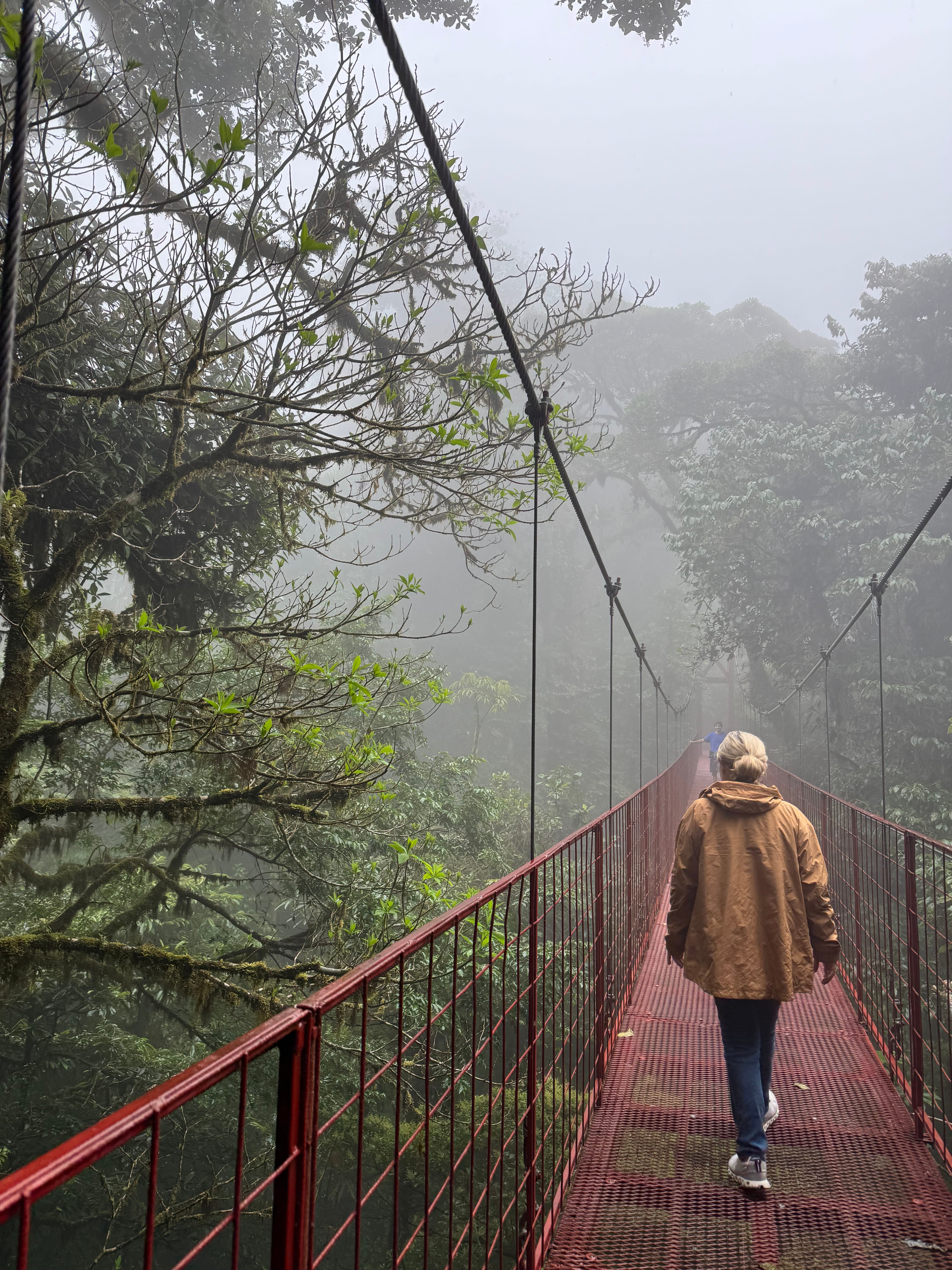
**Photo taking in Monteverde, Costa Rica in the cloud forest. We traveled there in September for the 3 year anniversary of Spencer’s death.
I am deep in the process of writing a memoir about my experience with traumatic memory and what happened when previously blocked memories came back in 2008. I am writing from the perspective of myself at the time as I encountered memory fragments, a house haunting, poltergeist activity and several bad influences all at the same time. If that sounds like absolute chaos to you, you are right. It was straight out of a Stephen King horror novel. The name of the book, for now, is The Cage.
I’ve known since 2009 I am supposed to write a book about these experiences. I remember when I felt this in my body for the first time: I am walking up some stairs and the feeling of awareness is so sudden and strong with conviction that I must sit down on the stairs to take it in. This moment of realization demands my full attention.
I didn’t start writing the book for 10 more years. I needed time to “live into” the book. In 2019, I felt the clear motivation to begin. I bought a notebook and began dumping out what was in my brain. I had pages and pages of notes, ideas, quotes, titles, chapter names, song lyrics, and diagrams of organization. I had also saved all my journals that chronicled my healing process. Then Covid happened and all my inspiration went on pause. My life then took an unexpected turn as my teenage son fought addiction and lost in 2022 when he died of fentanyl poisoning (another book to write). It wasn’t until October of 2023 that I joined a year-long book writing program through Booksmith Academy and began the writing process.
What do writing and books mean to me? Reading and writing are my favorite things in the whole world. Starting at 5 years old, I made book after book in kindergarten class. The books had construction paper covers with names like “The Story of the Cat”, “The Story of the Horse”, etc. Each page had a sentence and I drew a picture to go along with it. I have an entire box full of these books I made that year. I was also a self taught reader and was reading chapter books by the first grade. My favorite thing as a child was diving into a story and losing myself in another world. I didn’t consider writing professionally until mid life at age 36 while sitting on those stairs; that was my first instinctual nudge. From 2009 - 2019 I wrote out my pain in journals.
Along with the return of my memories, writing motivation and abilities also appeared.
So back to the title of this piece. How is writing about traumatic experiences different than other non-fiction writing, or fiction writing?
I made the rookie mistake of acting like I was just writing a story and realized this is not the way it works. I became frustrated when I couldn’t consistently dedicate 4 hours in the morning to writing, like a regular part time job. Steven King advocates this approach in his book, On Writing. And, he is talking about writing fiction. Writing about trauma, as demonstrated above in my years-long journey with it, is a unique process that has it’s own - life essence - that can’t be forced. Negotiated, perhaps. But certainly not forced. After all, “trauma” is what happens when our nervous system becomes overloaded and we are required to go beyond our bandwidth of coping. While attempting to force the writing out may yield a bit of writing, it resulted in more mental anguish than anything. And I refuse to re-traumatize myself.
But, isn’t writing about my trauma, re-traumatizing? Yes and no. There is a sweet spot, I’ve discovered.
By 2025 I had figured out how best to write in a way that didn’t result in constant re-traumatization. I managed to write 6 out of 7 chapters by adopting a detached “witness” persona as the writer. I felt pride in my work and wanted some professional feedback. In August I attended a writer’s retreat in Denmark called Hamlet’s Hideaway. It was hosted by two authors, Anja Klemp Vilgaard and Shawna Kenney, plus guest author Tembi Locke. The feedback I received about my chapter was positive, and also - daunting. There were red marks all over the place. They wanted to know more about this, and this, and this! One conversation written in dialogue could be it’s own chapter, they said. They loved it, it left them wanting more, and I could write a whole, 200 page book on the content in this one chapter. “This could be your book”, they told me. I just needed to “set the scene: go way deeper, tell us more about this and this, make us feel like we are there with you. Add some dialogue, SHOW US what you went through”.
GULP! At least it was crystal clear what was next. The feedback landed squarely on my heart and I felt the truth of their words. There was relief knowing exactly what I needed to do. I must take the reader from one event to the next, as if they are right there in it with me. But how?
A few weeks ago, “The Great Routine” revealed itself to me. I commit to just 1 hour a day of writing and/or spending dedicated time with my book. As a licensed therapist, I am used to the focused mental work of 1 hour increments with clients. I also associate the 1 hour time with being in my own therapy. I’ve practiced this for a few weeks now and I’ve been able to keep up with it. What usually occurs is that I end up writing for longer than the hour. And if I only write for 1 hour, I’ve met my daily commitment. I start writing around noon, after having the morning to meditate, read, journal and spiritually care for myself. This way, I am “setting the stage” for my own daily success.
One day, I did flip too far into the past and I found myself in a state of major dissociation due to writing out a very challenging scene. I immediately stop writing and stand up, unsure of what to do next. My head feels dizzy and swollen. I have greyed out and my thinking is hazy. I decide to lie down in my room, as I notice my back hurts. I immediately begin talking to Spencer, my son in spirit, and ask for spiritual help. Moments later, I feel a sudden burst of energy and I sit up in bed. An Ah-Ha moment about the scene bursts through, the fog in my mind evaporating immediately. I am able to return to the writing with a fresh perspective, feeling clear and energized.
I wrap this article up like many others to remind readers that spiritual support is always there, just waiting. It revealed itself to me in 2008 amidst all the chaos and confusion. It remains with me now as I write the memoir. It is there for you, too.
Don’t forget to ask for help.
Love this. Great that you found your 1-hour boundary. Sometimes a good day for me is 1 paragraph, sometimes it's a page or more. We really have to take care of ourselves when writing personal, especially traumatic, material.